
Installing solar panels on Irish farms
Learn how solar panels can help Irish farmers cut energy costs, improve efficiency, and futureproof their operations — all while supporting sustainability in agriculture.
Why solar panels make sense for Irish farms
Farms tend to use a lot of electricity during daylight hours — from milking parlours and refrigeration to lighting, ventilation, and machinery. That makes them well-suited to solar PV systems, which generate power when it’s needed most.
By generating your own electricity on-site, you can significantly reduce your reliance on the grid and protect yourself from energy price hikes.
What type of solar panels are used on farms?
Most farms in Ireland install solar PV (photovoltaic) panels, which convert sunlight into electricity to be used for day-to-day operations. These systems are typically:
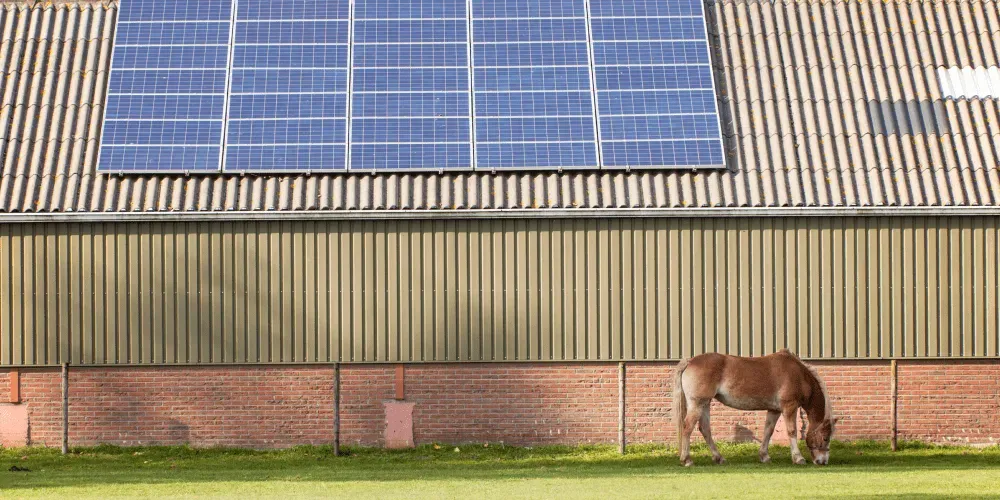
- Rooftop-mounted on barns, sheds, or outbuildings
- Or ground-mounted in unused areas or along field edges
Solar PV systems can be tailored to fit your farm’s size, layout, and energy usage, with options ranging from small-scale systems to larger commercial installations.
Benefits of solar energy in agriculture
- Lower electricity bills – generate your own power and reduce overheads
- Future proof your farm – gain energy independence as prices rise
- Make use of idle space – rooftops and unused land can be productive
- Reduce your carbon footprint – support Ireland’s climate targets
- Enhance your farm’s image – show customers and buyers you’re committed to sustainability
Over time, many farms see a strong return on investment, especially when grants and tax incentives are factored in.
Grants and financial support for farmers
Farmers can now access generous support for solar panel installations through a number of Irish and EU-backed schemes.
Targeted Agricultural Modernisation Schemes (TAMS 3):
- Offers up to 60% grant aid for renewable energy projects on farms
- Available for dairy, tillage, pig, and poultry farms, among others
- Covers solar PV systems, battery storage, and associated works
Accelerated Capital Allowance (ACA):
- A tax incentive allowing farms and businesses to write off the cost of solar equipment against taxable profits
SEAI grants (for small businesses and non-residential buildings):
- Available in some cases, particularly where commercial buildings are involved
It’s always worth speaking to your local Teagasc advisor or a registered solar installer to understand what you qualify for.
Do I need planning permission for solar on a farm?
Thanks to updated planning rules, most Irish farms can now install up to 300 square metres of rooftop solar panels per building without the need for planning permission.
For larger or ground-mounted systems, permission may be required — especially if the panels are near roads, boundaries, or heritage sites. A qualified installer can help guide you through this.
Ground-mounted vs rooftop solar systems
Type | Rooftop Solar | Ground-Mounted Solar |
|---|---|---|
Best for | Barns, sheds, outbuildings | Unused land or field edges |
Space requirement | No additional land needed | Requires clear, open ground |
Installation time | Quicker, often lower cost | May take longer and need permission |
Visual impact | Low (discreet on rooftops) | More visible but often unobtrusive |
Some farms opt for a hybrid system, using both rooftop and ground space to maximise output.
Get solar quotes for your farm
Installing solar panels is a smart investment for Irish farms looking to save money, become more self-sufficient, and meet sustainability goals.
At Solarpanels.ie, we make it easy to connect with trusted solar providers who understand the needs of Irish agriculture. Fill out a quick form to receive tailored quotes for your farm — and find out how much you could save.
Save time
Skip the hassle of chasing companies that offer good solar energy systems. Let the suppliers come to you instead.
Save money
Get offers from up to four competing solar suppliers and choose the one that meets your needs the most.
Free and non-binding
Choose whether you want to accept an offer or not. If you're not happy with any of them, you're free to decline them all.